Who Is Shesha? The Mythology Behind the Cosmic Serpent Who Holds Up the Worlds
At the bottom of Paatal Lok, below all seven realms, below even the great serpent king Vasuki, there is one being on whom everything rests. Hindu tradition calls him Shesha, or Ananta, or Adishesha, the first and the last of the serpents. He has a thousand hoods, he is wider than any ocean, and he is the bed on which Vishnu sleeps between the ages. He is the deepest answer in the whole of Indian mythology, and in our game he is the creature that watches over the final depth.
What the name means
The Sanskrit word shesha means what remains. The idea is that when the universe is dissolved at the end of an age, everything is taken back and only one thing is left, and that remainder is Shesha. This is why the old texts describe him as being there before creation and after destruction. His other name, Ananta, means endless. In the Hindi names of festivals and places it appears often. Ananta Chaturdashi, the last day of the Ganesh festival, is named after him, and the Kerala capital Thiruvananthapuram, the city of Sri Ananta, takes its name from the same word.
The bed of Vishnu
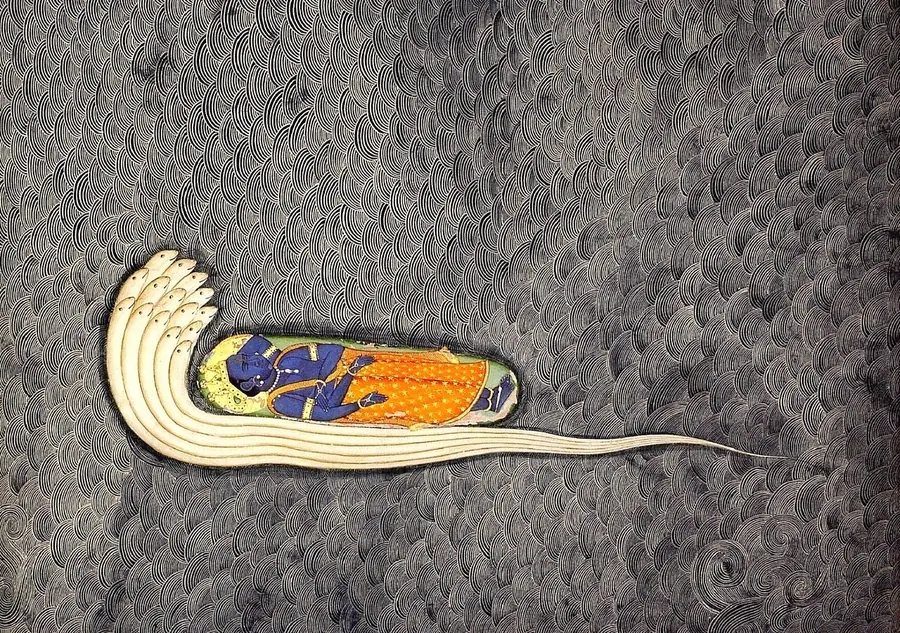
The best known image of Shesha shows Vishnu lying on his coils in the ocean of milk, Kshira Sagara, under a canopy formed by the serpent's hoods, with Lakshmi seated at his feet. Many temples show this scene, the reclining Vishnu, and in the great temple of Padmanabhaswamy in Thiruvananthapuram the main image of Vishnu lies on Ananta. The serpent here is not a threat or a monster. He is the support, the one who makes rest possible. The Puranas say that he serves Vishnu in many forms: as the bed, as the seat, as the umbrella and as the footstool.
The one who holds up the world
Canto 5 of the Bhagavata Purana, chapter 25, gives the fullest account of Shesha. It places him at the very bottom of the seven underground realms, at the base of Patala, and says that the whole universe rests on one of his hoods like a mustard seed. He is described as having a thousand hoods, each wearing a crown set with jewels, and as being so great that even the gods cannot reach the end of his qualities. He is also called Sankarshana in this account, which links him with the Vaishnava idea of Vishnu's own expansions.
Folk tradition adds that the earth is not still because Shesha is not still. When he shifts the weight from one hood to another, there is an earthquake. This is not in the oldest texts, and it should be treated as a popular belief, but it shows how deeply the image has entered everyday speech.
Shesha in the epics
Shesha appears in the epics in two forms of his own. In the Ramayana, Lakshmana, the younger brother of Rama who follows him into exile, is understood to be an incarnation of Shesha. The reasoning is simple: Shesha serves Vishnu in every age, so when Vishnu comes as Rama, Shesha comes as the brother who serves him. In the Bhagavata Purana, Balarama, the elder brother of Krishna, is likewise Shesha, which explains why he is described as pale in colour, carries a plough as his weapon, and is said at the end of his life to leave the world as a great white serpent from his mouth.
A third tradition links Shesha with a human teacher. Many Indian traditions say that Patanjali, the author of the Yoga Sutras and the commentary on Sanskrit grammar, was an incarnation of Shesha, and temples to Patanjali often show him with a serpent's lower body. This belief is traditional rather than historical, but it is a reminder of how often Shesha stands for knowledge, patience and support.
In the story of the churning of the ocean, told in the Mahabharata, it is Ananta who lifts Mount Mandara from the earth so that it can be used as the churning rod. The rope for the churning is Vasuki, a different serpent, who is the subject of another article on this blog. The two serpents work together: Ananta supplies the strength, Vasuki the length.
Shesha and the Nagas
It is useful to keep the serpent figures apart. Shesha is not a king of the Nagas in the way that Vasuki is. He is more like a cosmic principle, standing above them. In the Puranas he is the son of Kadru and the sage Kashyapa, the eldest of the thousand sons of Kadru, but he separated himself from his brothers, who were wicked, and performed austerities. Brahma, pleased by this, gave him the task of holding up the earth. This explains why Shesha is the one good serpent in a family of troublemakers, and why he is called the king of all Nagas in some texts, though Vasuki is the king in others.
Five heads in the game
In the Paatal game, the serpent who travels beside your dive, Sheshnaag, is drawn with five heads, not a thousand. It is a simplification, and a small one, but it gives the character a presence you can see on a phone screen. The scoring tiers are named after the beings of the realms, and the second rarest, Sheshanaga, is named after him. Above it sits the rarest of all, the Nagamani, the jewel that the serpent wears.
How Shesha is shown in art
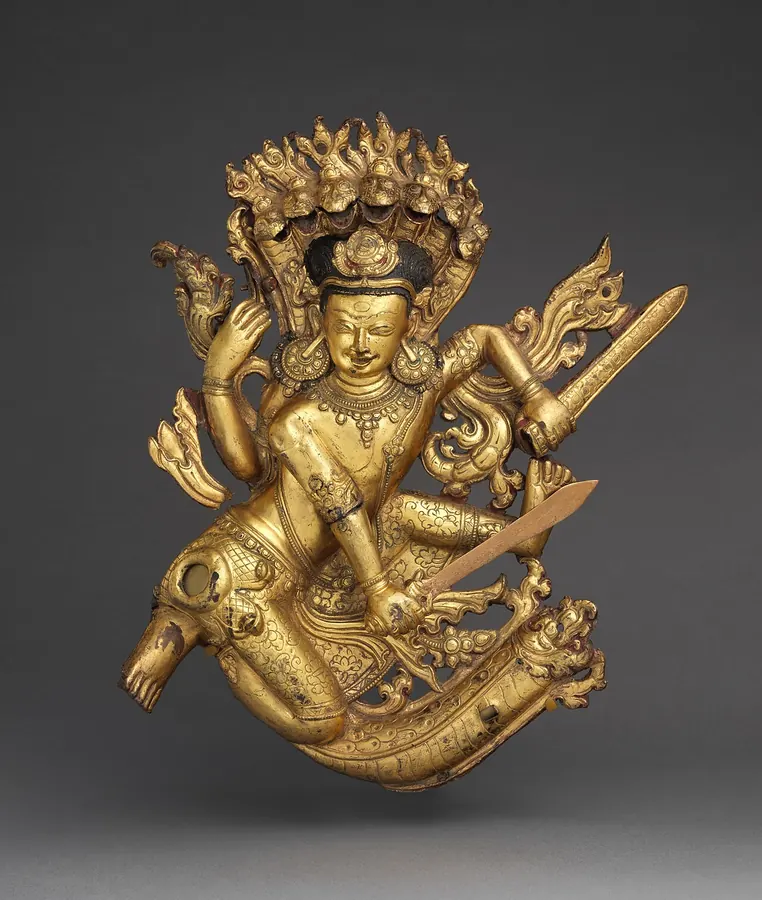
- As a seven-headed or five-headed serpent forming a canopy over a god, in temple sculpture across India and Southeast Asia.
- As a coiled bed under the reclining Vishnu, in the Anantashayana image found in Kerala, Karnataka and Tamil Nadu.
- As a half-human, half-serpent figure, often the form of Patanjali.
- As a white serpent rising from the mouth of Balarama at the end of his earthly life, in the Bhagavata Purana.
Why he matters
The figure of Shesha answers a question that many cultures ask: what is underneath everything? Many peoples have an answer that is a turtle, an elephant or a pillar. The Hindu answer is a serpent, a creature that is both feared and honoured, that lives underground, that sheds its skin and renews itself. The image says that what supports the world is not a dead weight but a living, patient presence, and that the foundations of the universe are alive.
If you would like to meet him in a different way, play today's quiz. The deeper your answers go, the nearer you come to the serpent at the bottom, and the realm pages on Paatal tell you what lives in each layer on the way.
Sources
- Bhagavata Purana, Canto 5, chapter 25 (the glories of Ananta, or Shesha).
- Mahabharata, Adi Parva (the churning of the ocean, in which Ananta lifts the mountain).
- Valmiki Ramayana and Bhagavata Purana, Canto 10 (Lakshmana and Balarama as forms of Shesha).
- Wikipedia, "Shesha".
Found a mistake? Please tell us at our contact page and we will correct the article and note the change.
Keep reading
Mahatala and the Serpents of Kadru: A Wager, a Curse and the Eagle Who Hunts Snakes
How a bet between two sisters, Kadru and Vinata, made the Nagas the enemies of Garuda, and what the Mahabharata tells us about Takshaka, Kaliya and the serpents of the fifth realm of Paatal Lok.
Vasuki and the Churning of the Ocean: The Serpent King Who Became a Rope
The story of Samudra Manthan, in which gods and demons used the serpent king Vasuki as a rope to churn the ocean of milk, and what came out of it, from poison to the nectar of immortality.
King Bali and Sutala: The Generous Asura Who Gave Three Steps of Land
The story of Bali, the asura king who lost the three worlds to Vishnu as Vamana, was sent to rule the realm of Sutala, and is welcomed back every year at Onam and on Bali Pratipada.