King Bali and Sutala: The Generous Asura Who Gave Three Steps of Land
There is a king in Indian mythology who is a demon by birth, a conqueror by choice and a hero by what he gave away. His name is Bali, also called Mahabali, and the realm he rules is Sutala, the third of the seven realms of Paatal Lok. He is unusual among the figures of the underworld because he is loved. In Kerala a whole festival is organised around the wish to see him again. This is his story.
A grandson of Prahlada
Bali was born in a famous family. His grandfather was Prahlada, the child devotee of Vishnu who survived the cruelty of his own father Hiranyakashipu, and his father was Virochana. Prahlada's devotion and sense of dharma passed down the family, so that even though Bali belonged to the asuras, the rivals of the gods, he was known for generosity, justice and truthfulness. He was taught by the sage Shukracharya, the guru of the asuras.
Under Bali's rule the asuras grew powerful. He defeated Indra and took control of the three worlds: the earth, the sky and the heavens. The gods, driven out of their homes, went to Vishnu for help. The Puranas are careful to say that Bali was not a cruel ruler. The problem was not his behaviour but the balance of the world, in which the gods had lost their place.
The dwarf at the sacrifice
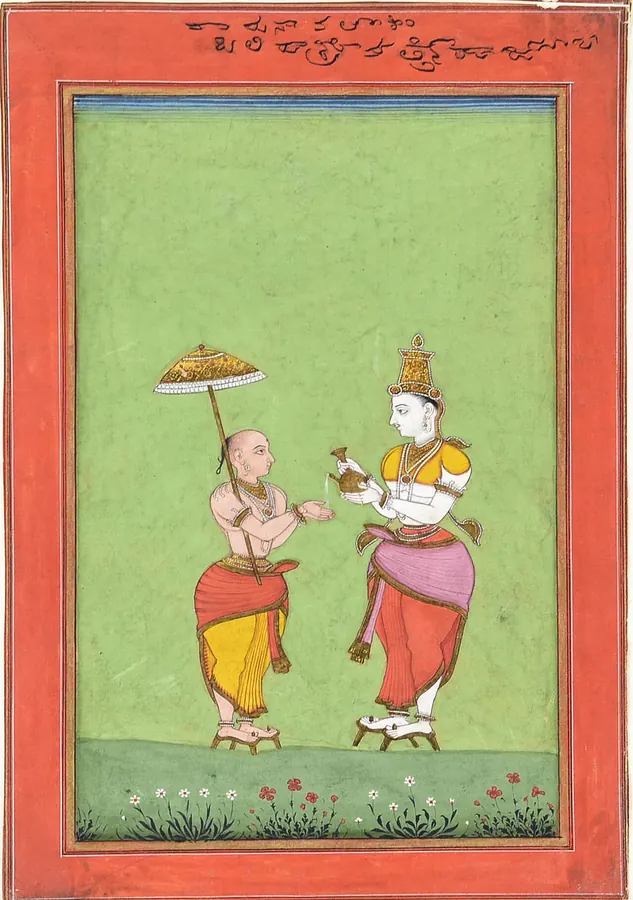
Vishnu answered by taking birth as Vamana, a young Brahmin boy, the fifth of his avatars, and the first to appear as a human. He was the son of Aditi and the sage Kashyapa. Bali was performing a great sacrifice, a yajna, and it was the custom that he would give whatever was asked of him on that day. Vamana, small, with an umbrella and a staff, came to the sacrifice and asked for a gift of land: just as much as he could cover in three steps.
Shukracharya understood who the boy was and warned Bali not to promise. Bali replied that a king who has promised cannot take it back, and that if the one asking was Vishnu himself, it was an honour to give. He poured the water of the gift into Vamana's hand.
Three steps
Then Vamana began to grow. In one step he covered the whole earth. In the second he covered the sky and the heavens. There was nothing left for the third. Vamana asked where he should put his foot. Bali, who had kept his word until there was nothing left to keep it with, bowed and offered his own head.
Vamana placed his foot on Bali's head and pressed him down into the underworld. But the Bhagavata Purana is clear that this was not a punishment. Vishnu was pleased by Bali's truthfulness, and he gave him rulership of Sutala, a realm, the text says, richer than the heaven of Indra. The palaces there were made by Vishvakarma, the divine architect, and Vishnu himself agreed to stand at Bali's gate as his guard. The king who lost the three worlds gained a kingdom and a protector.
Sutala as a place
The Bhagavata Purana places Sutala third in the order of the lower realms, below Atala and Vitala. Like the other underground heavens, it is described as free from the troubles of the world: no disease, no old age and no fatigue, and nothing lacking.
Onam: the day the king returns
The festival that remembers Bali is Onam, celebrated in Kerala in the month of Chingam, usually August or September. According to the tradition, Bali, whom the Malayalis call Mahabali or Maveli, was such a good ruler that his people were happy, honest and equal, and the gods were jealous. As part of the boon at the end of his story, he was allowed to return once a year to see his subjects. On the day of Thiruvonam, the people welcome him.
The preparations are among the most colourful of any Indian festival:
- Pookalam, a carpet of flowers laid in the courtyard, grows larger each day for ten days.
- Onasadya, a vegetarian feast served on a banana leaf with more than twenty dishes.
- Vallam Kali, the snake boat races, in which long boats with a hundred rowers race on the backwaters.
- Pulikali, a procession of men painted as tigers and leopards, in Thrissur.
- Onakodi, new clothes, given to family members.
The Thrikkakara temple near Kochi is dedicated to Vamana and is the centre of the old Onam traditions. Here the story is told with a twist that many Malayalis love: that Vamana is not a hero who tricked a king, but a god who was honoured by a generous man.
Bali Pratipada and Bali Padyami
Kerala is not the only place that remembers him. In north and west India, the day after Diwali is called Bali Pratipada, and is sometimes called Bali Padyami in Karnataka and Andhra. In many homes people draw a picture of King Bali in rangoli on the floor, with his wife and attendants, and worship him as a symbol of generosity. In Maharashtra, the saying is Ida pida talo, Baliche rajya yevo, may sorrow go and the kingdom of Bali come. It is a prayer for good rule, using Bali as the picture of a just king.
Why the story is told in two ways
Is Bali a villain who was defeated or a hero who was rewarded? Both readings exist, and the tradition does not insist on one. For those who see Vishnu as the main figure, the story is a lesson in the order of the world and the importance of surrender. For those who stress Bali, it is a lesson in generosity, the idea that giving everything, even the self, is what makes a person great. The Bhagavata Purana reconciles the two by making Bali one of the great devotees. He is one of the twelve mahajanas of that text, the great authorities on devotion.
The idiom
In everyday Hindi, the phrase Bali ka bakra, the goat of the sacrifice, is used for a person who is made to take the blame, and Bali is also the root of the word for offering, bali. The two are not directly connected to King Bali, whose name means the strong one, but they show how deeply the sound of the name is part of Indian speech.
Sutala in the game
In the Paatal game, Sutala covers depths from 2,000 to 3,000 metres. Players who reach it have usually given answers that only some people know. If you want to see how the realm is described in the game, its page tells you about the palace, the guard at the gate and the king who gave away everything he owned.
Sources
- Bhagavata Purana, Canto 8, chapters 15 to 23 (Bali and Vamana), and Canto 5, chapter 24 (Sutala).
- Vishnu Purana, Book 3, and the Vamana Purana.
- Wikipedia, "Mahabali" and "Vamana", and the Government of Kerala's tourism pages on Onam.
Found a mistake? Please tell us at our contact page and we will correct the article and note the change.
Keep reading
Vasuki and the Churning of the Ocean: The Serpent King Who Became a Rope
The story of Samudra Manthan, in which gods and demons used the serpent king Vasuki as a rope to churn the ocean of milk, and what came out of it, from poison to the nectar of immortality.
Mahatala and the Serpents of Kadru: A Wager, a Curse and the Eagle Who Hunts Snakes
How a bet between two sisters, Kadru and Vinata, made the Nagas the enemies of Garuda, and what the Mahabharata tells us about Takshaka, Kaliya and the serpents of the fifth realm of Paatal Lok.
Maya, the Architect of the Asuras: Tripura, the Pandavas' Hall and the Realm of Talatala
Maya Danava, the great builder of Indian epics, built the flying cities of Tripura and the hall of the Pandavas at Indraprastha, and rules Talatala, the fourth realm of Paatal Lok.