Vasuki and the Churning of the Ocean: The Serpent King Who Became a Rope
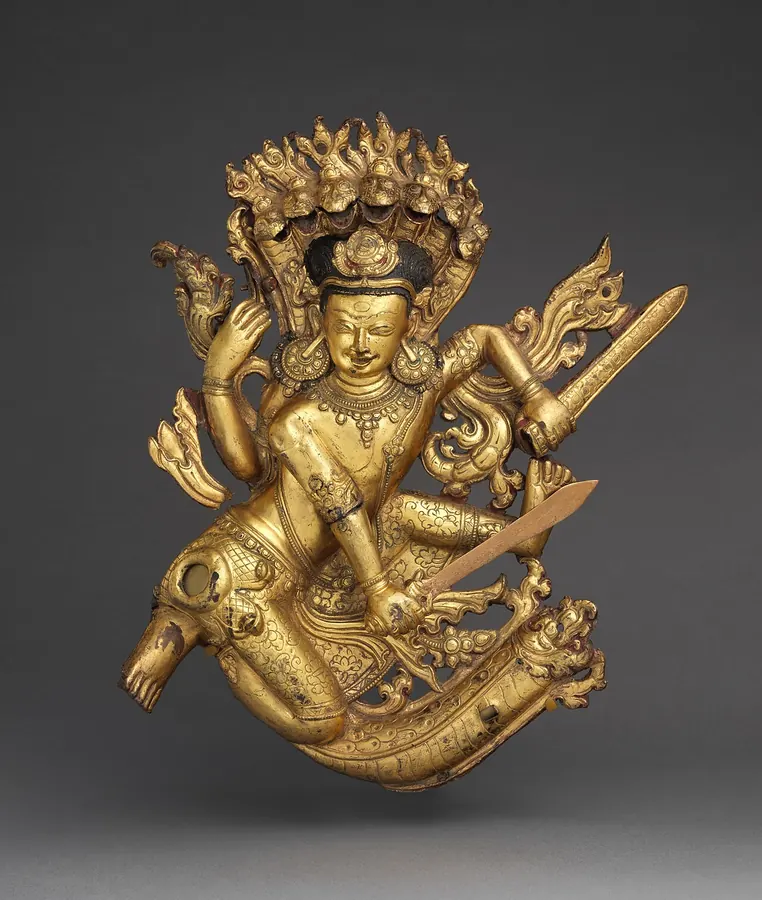
Of all the stories in Indian mythology, the churning of the ocean is among the most retold. It is carved on the walls of Angkor Wat in Cambodia, shown as a giant sculpture in an airport in Bangkok, painted in temples across India, and linked to the largest religious gathering in the world, the Kumbh Mela. At its centre is a serpent: Vasuki, the king of the Nagas, who lives in Patala, the lowest of the seven realms. In this story he is not a ruler but a rope.
Why the ocean was churned
The story begins with the gods, the devas, who had grown weak after a curse from the sage Durvasa. The asuras, their half-brothers and rivals, were stronger. Vishnu advised the gods to make a truce with the asuras and to work together to churn the ocean of milk, the Kshira Sagara, in order to produce amrita, the nectar of immortality. The gods planned to take the nectar for themselves, but they needed the asuras' strength, so they were willing to share the work and to promise a share of the reward.
The equipment
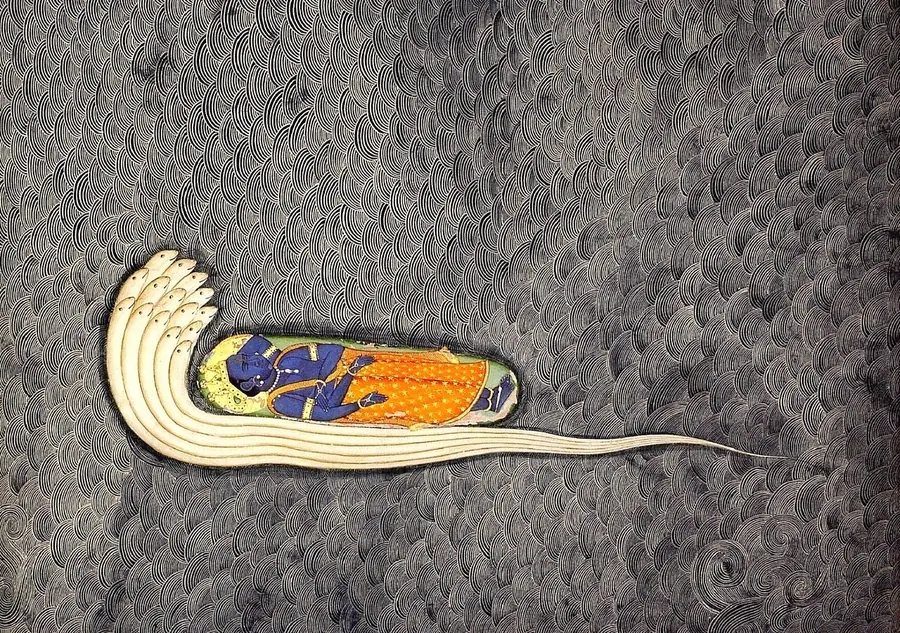
A churning needs a pot, a rod and a rope. The ocean was the pot. The rod was Mount Mandara, a huge mountain, which was uprooted and carried to the shore, in the Mahabharata's account by the serpent Ananta, also called Shesha. The rope was Vasuki, who agreed to be wound around the mountain. The asuras held his head, the devas his tail, and they pulled in turns, so that the mountain spun first one way, then the other.
But the mountain was heavy and began to sink into the sea. Vishnu then took the form of a giant tortoise, Kurma, his second avatar, and held the mountain on his back. The churning could go on.
What Vasuki suffered
A rope is not meant to be comfortable. As the mountain turned, Vasuki's body was rubbed raw, and the Puranas say that fire and smoke came from his mouths and that the asuras who held his head were scorched by his breath. He did this willingly, and in the end his suffering produced the first thing that came out of the sea, and it was not good.
The poison
The first thing to rise from the ocean was Halahala, a terrible poison, that spread through the world and threatened to destroy everything. The gods and asuras fled to Shiva for help. Shiva swallowed the poison, but his wife Parvati pressed his throat, so that it did not pass into his body. The poison stayed in his neck and turned it blue. That is why Shiva is called Neelakantha, the blue-throated one. Vasuki is often shown coiled around Shiva's neck as well, and the two images are easy to confuse.
The treasures
After the poison, the churning produced a series of treasures. The lists differ in different books, but the commonly named ones are these:
- Kamadhenu, the cow who grants every wish.
- Uchchaihshravas, the white horse with seven heads, taken by Indra.
- Airavata, the white elephant, who became Indra's mount.
- The Kaustubha jewel, taken by Vishnu.
- The Parijata, a tree of heaven.
- Apsaras, the celestial dancers, among them Rambha.
- Lakshmi, the goddess of fortune, who chose Vishnu as her husband.
- Varuni, the goddess of wine.
- The moon, who took his place on the forehead of Shiva.
Last of all came Dhanvantari, the physician of the gods, carrying a pot of amrita. At once the asuras seized the pot, and a fight began.
Mohini and the nectar
Vishnu stopped the fight by taking the form of Mohini, a woman so beautiful that the asuras forgot the nectar and gave her the pot. She offered to distribute it fairly, and then served the gods first. One asura, Svarbhanu, disguised himself as a god and drank some, but the sun and moon noticed and told Vishnu, who cut off his head with his discus. The head, having tasted the nectar, was immortal. It became Rahu, and the body became Ketu, and the story says that they take their revenge on the sun and moon at every eclipse.
Where the Kumbh comes from
A well known tradition says that while the gods and asuras fought for twelve days, which are said to equal twelve years in human time, drops of amrita fell at four places on earth: Prayagraj, Haridwar, Ujjain and Nashik. These four places host the Kumbh Mela in rotation. Kumbh itself means pot, the pot that held the nectar. The story is the reason that millions of people bathe in these rivers on certain dates.
Vasuki after the churning
In the Mahabharata, Vasuki appears again. When the serpent race was threatened by a curse, in which King Janamejaya would perform a great sacrifice to burn all snakes, Vasuki helped to arrange that his sister Jaratkaru would marry a sage of the same name. Their son Astika, half Naga and half human, stopped the sacrifice. Nag Panchami is still celebrated in part as a thanks to the serpent family. In Bengal and in other parts of eastern India, the serpent goddess Manasa is considered the sister of Vasuki.
What the story means
The churning is a story about cooperation between enemies, the cost of great things and the order in which good and bad come out of effort. The poison comes first, and someone has to hold it. The treasures come next, and everyone wants them. The nectar comes last, and it is the hardest to share. Vasuki's part is the one that makes the whole thing possible and that is least noticed. A rope disappears into the work.
It is also a fine story to illustrate the idea behind the Paatal game. The famous answers, such as the nectar and Lakshmi, are known to nearly everyone. The rarer ones, such as Airavata, Uchchaihshravas and the Kaustubha, are known to few. The deepest, the rope that held the mountain, is easy to miss. In a Paatal question, the answer that almost no one remembers takes you the furthest down.
Sources
- Mahabharata, Adi Parva (the churning of the ocean).
- Bhagavata Purana, Canto 8, chapters 5 to 12 (Samudra Manthan and Mohini).
- Vishnu Purana, Book 1, chapter 9.
- Wikipedia, "Samudra Manthan" and "Vasuki".
Found a mistake? Please tell us at our contact page and we will correct the article and note the change.
Keep reading
King Bali and Sutala: The Generous Asura Who Gave Three Steps of Land
The story of Bali, the asura king who lost the three worlds to Vishnu as Vamana, was sent to rule the realm of Sutala, and is welcomed back every year at Onam and on Bali Pratipada.
Mahatala and the Serpents of Kadru: A Wager, a Curse and the Eagle Who Hunts Snakes
How a bet between two sisters, Kadru and Vinata, made the Nagas the enemies of Garuda, and what the Mahabharata tells us about Takshaka, Kaliya and the serpents of the fifth realm of Paatal Lok.
Who Is Shesha? The Mythology Behind the Cosmic Serpent Who Holds Up the Worlds
Shesha, also called Ananta, is the thousand-headed serpent on whom Vishnu rests. What his name means, where he appears in the Puranas and epics, and why he is born again as Lakshmana and Balarama.