The Nagamani: The Legend of the Serpent Jewel, from the Puranas to Hindi Cinema
Among all the objects of Indian folklore, few are as famous and as fictional as the nagamani, the jewel that is said to sit on the hood of a great serpent. It is supposed to glow in the dark, to cure poison, to bring wealth to whoever owns it and to be guarded by the snake with a ferocity that no hunter can overcome. In our game it is the name of the rarest tier, the answer worth the most. This article looks at where the idea comes from, what the old texts actually say and where the legend has gone since.
The jewels of Patala
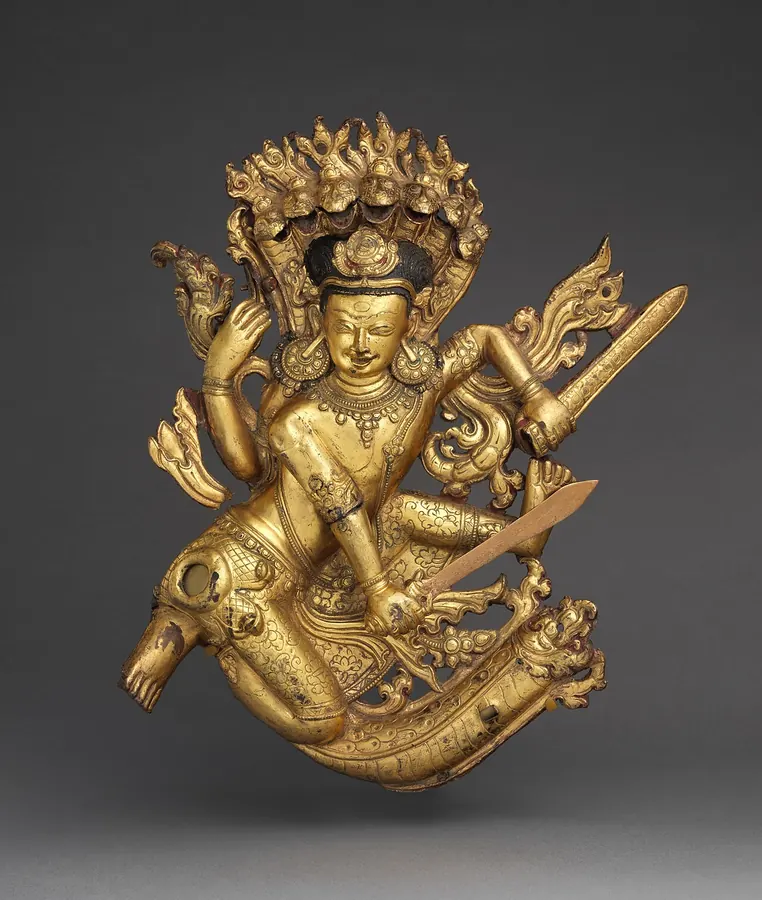
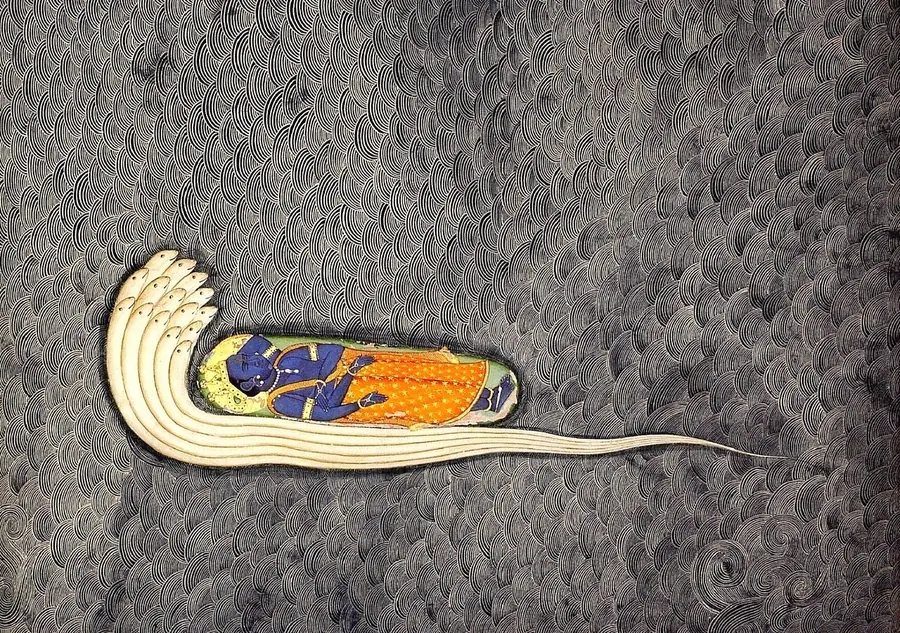
The oldest source for the picture is the description of Patala in the Puranas. The Vishnu Purana, in its fifth chapter of the second book, says that in the lowest of the seven realms there is no sun, and that the darkness is lit by the jewels on the hoods of the great serpents. The Bhagavata Purana says the same: the Nagas of Patala, whose hoods number five, seven, ten, a hundred or a thousand, each wear a jewel, and the light of all of them together drives out the darkness of the underworld.
So the oldest version of the idea is not about a single magical stone, but about a society of serpents, each wearing a gem as a crown, and together lighting a whole world. The jewel is a sign of rank. The more hoods a serpent has, the more jewels it carries, and the kings of the Nagas, Vasuki and Takshaka, are the most splendidly lit.
From crown to talisman
Over the centuries, the picture changed. In folk belief, the jewel became a single object, the nagamani or naga mani, that a snake carried in its mouth or on its head. People said that old cobras, which had lived for a hundred years or more, grew a stone, and that the stone gave light at night, so that the snake could hunt. Some versions say that a snake puts the stone on the ground and hunts by its light, and that the stone must not be touched or the snake will take revenge. Others say that a stone obtained from a serpent will cure any poison, or make the owner rich.
This belief is found in many parts of India and also across Southeast Asia, wherever the idea of the naga has travelled. In the Sanskrit tradition, the mani is any jewel, and the many other jewels of mythology, such as the Kaustubha of Vishnu and the Syamantaka of Satrajit, give the word a long history. The nagamani adds to it the special thrill of danger: a jewel that is not easy to take.
The ichchadhari naagin
Hindi cinema made the nagamani into a genre. Ichchadhari, the one who takes a shape by will, is the name for the shapeshifting serpent of folk tradition, the naag or naagin who can appear as a human being. In the popular film tradition, the naagin carries the nagamani, and she is seen as a loving wife, a vengeful spirit or both.
- Nagin (1954), with Vyjayanthimala and Pradeep Kumar, was a huge hit, helped by a song, Man dole mere tan dole, in which the snake charmer's been is played in the music.
- Nagina (1986), with Sridevi as the naagin, took the idea to a new generation. Its song Main teri dushman has been imitated countless times.
- Nagin, the television serial that began in 2015 and ran for many seasons, brought the legend to a mass audience, with elaborate effects.
- A common film belief is that a naagin can see the face of the killer of her mate in the eye of the dead snake, and that she will find him. There is no basis for this in the Puranas, or in nature, but it is the source of many films.
It is notable that the jewel of the cinema is usually the thing the villain wants, and the naagin protects. The tradition treats the nagamani as something whose possession is dangerous. It is not a prize, but a trial.
What is true, and what is not
There is no snake that carries a jewel. No cobra, python or other species grows a gem on its head or in its mouth. Herpetologists, who study snakes, have found no evidence for any such thing, in India or elsewhere. Various explanations of how the legend began have been suggested, but none is established. The more convincing one is that the idea comes from the older picture of serpents with jewelled crowns, which is a symbol of royalty and wealth, and then became a story about a single stone.
This matters because the legend has real consequences. News reports from India regularly describe fraudsters who claim to sell a nagamani for a very high price. What is sold is an ordinary stone or a piece of glass, and the buyers lose their money. Snakes have also been captured and harmed because of the same belief. Snakes are protected animals in India under the Wildlife (Protection) Act, 1972, and keeping, hunting or exhibiting them is a crime.
A few other things about snakes and folklore
- Snakes do not drink milk. Offering milk to a snake on Nag Panchami can harm it, and herpetologists ask people to offer milk to the serpent's image instead.
- Snakes cannot hear music in the way people do. A snake charmer's snake follows the movement of the pipe, not the sound of the tune.
- Snake charming is now illegal in India, and the snake charmer's community has been helped to find other work.
- Not all snakes are poisonous. Most of India's snakes are harmless, though four, the cobra, krait, Russell's viper and saw-scaled viper, cause most of the serious bites.
Why the Nagamani is the top tier
In Paatal, the six scoring tiers are named for the beings of the underworld, from the common Yaksha at the top to the rarest, the Nagamani, at the bottom. An answer that earns the Nagamani is one that almost nobody gives, worth 1,000 metres. We chose the name because it fits the idea of a rare thing in a dark place: a light that only a few ever see. It is the jewel that the whole world below is lit by, and the one that is hardest to get.
It is also deliberately scarce in the game. The Nagamani for any one answer to any one question is given to only a small number of players in a given time, so that it remains a rarity and not an everyday result. Like the legend, it is a thing that most players hear about and few see.
Sources
- Vishnu Purana, Book 2, chapter 5 (the jewelled hoods of the Nagas of Patala).
- Bhagavata Purana, Canto 5, chapter 24 (Patala and Vasuki).
- Wikipedia, "Naga (mythology)", "Nagin (1954 film)" and "Nagina (1986 film)".
- The Indian Wildlife (Protection) Act, 1972, on the keeping and handling of snakes.
Found a mistake? Please tell us at our contact page and we will correct the article and note the change.
Keep reading
Mahatala and the Serpents of Kadru: A Wager, a Curse and the Eagle Who Hunts Snakes
How a bet between two sisters, Kadru and Vinata, made the Nagas the enemies of Garuda, and what the Mahabharata tells us about Takshaka, Kaliya and the serpents of the fifth realm of Paatal Lok.
Vasuki and the Churning of the Ocean: The Serpent King Who Became a Rope
The story of Samudra Manthan, in which gods and demons used the serpent king Vasuki as a rope to churn the ocean of milk, and what came out of it, from poison to the nectar of immortality.
Who Is Shesha? The Mythology Behind the Cosmic Serpent Who Holds Up the Worlds
Shesha, also called Ananta, is the thousand-headed serpent on whom Vishnu rests. What his name means, where he appears in the Puranas and epics, and why he is born again as Lakshmana and Balarama.