Rasatala: The Realm of the Daityas and Danavas, and Why We Say Someone Has Gone There
The Hindi language has an expression for complete ruin: rasatal mein jana, to go to rasatala. A business that has failed, a career that has collapsed, a team that has lost every match: all can be said to have gone to rasatal. The phrase is so common that most people who use it do not know it refers to a place in the old cosmology, the sixth of the seven realms of Paatal Lok. This article looks at who lives there, what they are afraid of and how the name came to mean disaster.
The children of Diti and Danu
The Puranas explain the asuras through a family tree. The sage Kashyapa had many wives, who were the daughters of Daksha, and each became the mother of a different kind of being. Aditi was the mother of the gods, the Adityas. Diti was the mother of the Daityas, and Danu of the Danavas. Their relatives include the Nagas, who come from Kadru, the birds, from Vinata, and many other races. In the Puranic picture, the whole of creation is one extended family, and the wars between the gods and the asuras are quarrels between half-brothers.
The Daityas and Danavas are the main inhabitants of Rasatala. The Bhagavata Purana adds three more groups: the Panis, the Nivatakavachas and the Kaleyas, and also the Hiranyapuravasins, those who live in the golden city. The Daityas and Danavas are described as strong and as being in constant conflict with the gods, though they live, the text says, in holes in the ground like snakes.
The Panis and the stolen cows
The Panis are older than the Puranas. They appear in the Rigveda, the oldest text in the Sanskrit tradition, where they are described as merchants or misers who hoard wealth and refuse to give it to the gods. The most famous hymn about them is Mandala 10, hymn 108, a dialogue between the Panis and Sarama.
The story is this. The Panis had stolen the cows of Indra, or of the Angirasa sages, and had hidden them in a cave in the mountains. Indra sent Sarama, a female dog, to find them. She crossed the river Rasa and found the Panis, who tried to bribe her to stay and to make her a sister, and even offered her a share of the cattle. She refused, and returned to Indra with the news. In the later tradition, Indra and the Angirasas then broke open the cave and freed the cows.
It is a small detail with a big echo. The name of the river, Rasa, is the same root as the word that gave Rasatala its name. Sarama is the ancestor of all dogs in the Indian tradition, the mother of the dogs of Yama, and in Rasatala the Panis are said still to be afraid of her.
The Nivatakavachas and the Kaleyas
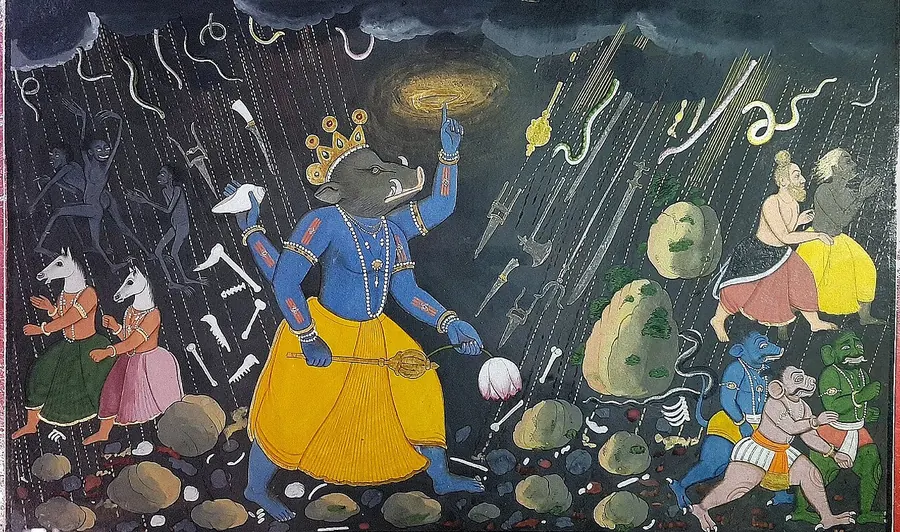
Two other groups of Rasatala appear in the Mahabharata. The Nivatakavachas, whose name means those clad in impenetrable armour, were three crore of demons who lived beneath the sea. Arjuna visited the heavens to learn the use of divine weapons from Indra, and as payment for his teaching Indra asked him to destroy the Nivatakavachas, who were troubling the gods. Arjuna did so, with the divine weapons he had been given. The Kaleyas, another group of asuras, appear in the stories of the sage Agastya, who is said to have drunk the ocean so that the gods could find them hiding at its bottom.
The name that became an idiom
The word rasa in Sanskrit means juice, taste, essence and also water, and the word tala means level or bottom. So Rasatala can be read as the level of waters. It would not seem to be a name for ruin. But in everyday speech the sense has shifted. Because Rasatala is one of the lowest realms, and the one where the enemies of the gods live, going there came to mean falling to the very bottom.
It is used for people and for things: a country, a business, a career or a price can all be said to have gone to rasatal. The phrase has the same sense as falling to the bottom of a pit, and it is a good example of how an idea from cosmology passes into daily language and loses its connection to its source. Few of the people who say it are thinking of the Daityas.
Prahlada, a Daitya among the Daityas
The best known story of the Daityas is the story of Prahlada. His father, Hiranyakashipu, a Daitya king, had been granted a boon that made him almost impossible to kill, and he demanded that everyone worship him. His small son refused, and said that he would worship Vishnu alone. After many attempts on the boy's life, Vishnu appeared from a pillar as Narasimha, half man and half lion, and killed the king in the doorway at twilight, a way of dying that the boon had not covered. Prahlada became king, and in the family of the Daityas he is remembered as one of the greatest devotees. The same family produced Bali, who is the subject of another article here.
Are the Rasatala people villains?
The Puranic picture is more complicated than it seems. The asuras are not simply evil. Prahlada, the great devotee of Vishnu, was a Daitya. Bali, the generous king, was his grandson. Maya, the great architect, was a Danava. The realm of Rasatala is the place where the rivals of the gods live, but it is also the place that produced some of the greatest figures of the tradition. The tradition does not draw a line between good and bad races. It draws a line between good and bad acts.
This is one reason why the realm is so interesting. If you ask who lives in the sixth realm of Paatal Lok, you get two answers: the enemies of the gods and the family of the gods. These are the same people.
Rasatala in the game
In the Paatal game, Rasatala is the sixth of the seven depths, spanning 5,000 to 6,000 metres. To get there, a player has to give answers that very few people give, and the realm that follows, Patala, is reached only by the deepest answers of all.
If you would like to try, the daily quiz opens every day at midnight, Indian Standard Time, and the realm pages tell you more about each layer on the way down.
Sources
- Bhagavata Purana, Canto 5, chapter 24 (Rasatala) and Canto 6 (Diti, Danu and their sons).
- Rigveda, Mandala 10, hymn 108 (the dialogue of Sarama and the Panis).
- Vishnu Purana, Book 1, chapter 21 (the children of Kashyapa).
- Wikipedia, "Daitya", "Danava", "Pani (Rigveda)" and "Sarama".
Found a mistake? Please tell us at our contact page and we will correct the article and note the change.
Keep reading
King Bali and Sutala: The Generous Asura Who Gave Three Steps of Land
The story of Bali, the asura king who lost the three worlds to Vishnu as Vamana, was sent to rule the realm of Sutala, and is welcomed back every year at Onam and on Bali Pratipada.
Mahatala and the Serpents of Kadru: A Wager, a Curse and the Eagle Who Hunts Snakes
How a bet between two sisters, Kadru and Vinata, made the Nagas the enemies of Garuda, and what the Mahabharata tells us about Takshaka, Kaliya and the serpents of the fifth realm of Paatal Lok.
Maya, the Architect of the Asuras: Tripura, the Pandavas' Hall and the Realm of Talatala
Maya Danava, the great builder of Indian epics, built the flying cities of Tripura and the hall of the Pandavas at Indraprastha, and rules Talatala, the fourth realm of Paatal Lok.