
The Idea Behind Paatal: Why a Rare Answer Is Worth More Than a Right One
Imagine a quiz that asks you to name a Prime Minister of India. Most people say Modi or Nehru, and they are right. Fewer say Manmohan Singh or Indira Gandhi. A few say Chandra Shekhar or I. K. Gujral. And almost no one says Gulzarilal Nanda, who was India's Prime Minister twice, for a total of twenty-six days, and who is still in the history books as the acting Prime Minister who held the office when it needed holding. All of these answers are correct. Yet they are not equally impressive, and a quiz that treats them alike is missing something. That thought is where Paatal began.
The problem with one right answer
Most quiz games ask a question that has a single answer. Who wrote the Arthashastra? What is the capital of Australia? The player either knows it or does not, and the game scores one point for knowing it. This format is simple, but it has two weaknesses. It tests recognition, not recall, which is a much weaker kind of knowledge. And it makes everyone's score depend on the same facts, so that the game quickly becomes a test of who has memorised the standard list.
A question with many right answers is different. Name a river of India, a Prime Minister, a character from the Ramayana, a Jyotirlinga. Each of these has a dozen or a hundred right answers. A person can answer from the top of the list or from the bottom, and the interesting thing is where in the list they go.
Gulzarilal Nanda, the forgotten Prime Minister
The story of Gulzarilal Nanda shows the idea well. He was a labour economist from Sialkot, in what is now Pakistan, who became a leader of the Congress and of the trade union movement, and was a minister for labour and employment, planning and home affairs. When Jawaharlal Nehru died in office on 27 May 1964, Nanda, as the senior-most minister, was sworn in as the acting Prime Minister, and he served for thirteen days until Lal Bahadur Shastri was chosen. When Shastri died in Tashkent on 11 January 1966, Nanda was again sworn in as acting Prime Minister, and again served thirteen days, until Indira Gandhi was elected leader of the party. Nanda was awarded the Bharat Ratna in 1997, and he died in 1998 at the age of ninety-nine.
Is he a Prime Minister of India? He is, in the sense that he held the office, but he is not counted in the numbering of the Prime Ministers, which gives Narendra Modi as the fourteenth. So the answer is right and also easy to forget. And that is what makes it a good example. Nearly everyone remembers Nehru, and few remember Nanda, and the difference is not a matter of who matters more. It is a matter of who is easy to recall.
Turning rarity into depth
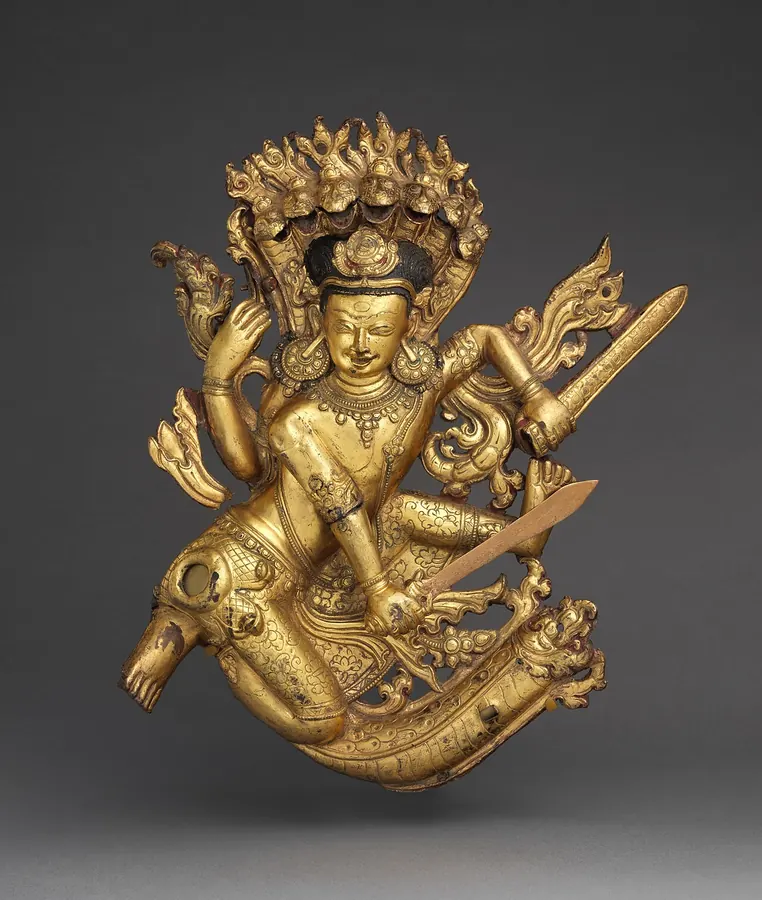
In Paatal, each question has dozens of right answers, and each answer has a tier, based on how many players are likely to give it. The tiers are named after the beings of Paatal Lok, from the most common to the rarest:
- Yaksha: 100 metres. The answer almost everyone gives.
- Daitya: 150 metres.
- Danava: 300 metres.
- Nagaraja: 600 metres.
- Sheshanaga: 850 metres.
- Nagamani: 1,000 metres. The answer almost no one gives.
Your score is your depth. There are seven questions a day, and if you gave the rarest possible answer to all seven, you would reach 7,000 metres, the floor of Patala. Each realm spans 1,000 metres of depth, and the game shows you which realm you reached.
Why depth and not points
We chose depth as the measure because it matches the idea. The deeper you go, the less light there is, and the fewer people have been there. It also gives the player a picture to hold, which a number cannot do. A score of 4,250 metres puts you in Mahatala, the realm of the serpents, and you can read about it. A score of 580 does not mean much.
There is also a practical reason. The Puranas describe seven realms of Paatal Lok, in a fixed order, and a quiz with seven questions fits naturally. The structure was there before we started.
How the tiers are decided
A rarity score is only useful if it is true, and a guess by the author is not a good source. So the tiers start with an estimate, and then they change as players answer. Once an hour, the game looks at how many people gave each answer and moves an answer one step up or down if the crowd disagrees with the estimate. An answer that everyone gives becomes more common, and an answer that no one gives becomes rarer. This is why the game gets better with players.
It has another effect, which is that it is difficult to cheat. If one player finds a rare answer and shares it, the answer becomes common and loses value. The rare answer is only valuable while it is rare.
Rarity is not obscurity
One thing the game tries to avoid is asking questions that are simply hard. A question that has one obscure answer is not interesting. The rarity in Paatal comes from choice, not difficulty: many right answers, of which most people give the same few. The player who thinks of a different one, one that is also correct, is rewarded.
That is also why the answers have to be right. A rare answer is not the same as a wrong answer, and a wrong answer scores nothing. The skill is to find the right answer that others overlook, and that is a skill of knowledge, not of luck.
Try it
Every day a new set of seven questions opens at midnight, Indian Standard Time. You get twenty-five seconds for each. Give a right answer and you go down. Give a rarer one and you go further. If you want to read more about the realms you will pass through, they are described in the articles on this blog, starting with the complete guide to the seven realms.
Sources
- Wikipedia, "Gulzarilal Nanda" and "List of prime ministers of India".
- Prime Minister's Office, Government of India, "Former Prime Ministers".
- Bharat Ratna award lists, Government of India (Nanda, 1997).
Found a mistake? Please tell us at our contact page and we will correct the article and note the change.
Keep reading
The Prime Ministers of India: The Full List, the Shortest Terms and the Ones People Forget
All fourteen Prime Ministers of India in order, with the terms that were shortest, the Prime Minister who never faced Parliament, the two who died in office and the acting Prime Minister who is not counted.
Mumbai or Bombay? Why Indian Names Have So Many Spellings, and What It Means for Quizzes
Why Vishwanathan and Viswanathan, Mahabharata and Mahabharat, Bombay and Mumbai are all the same answer: how Indian names are written in Roman letters, how city names changed, and how a trivia game can accept them all.
The Twelve Jyotirlingas of Shiva: Where They Are, the Legend Behind Them and Where the Lists Disagree
A guide to the twelve Jyotirlingas: Somnath, Mallikarjuna, Mahakaleshwar, Omkareshwar, Kedarnath, Bhimashankar, Kashi Vishwanath, Trimbakeshwar, Vaidyanath, Nageshwar, Rameshwaram and Grishneshwar, and the disputes over three of them.